 Fundamentals Hub
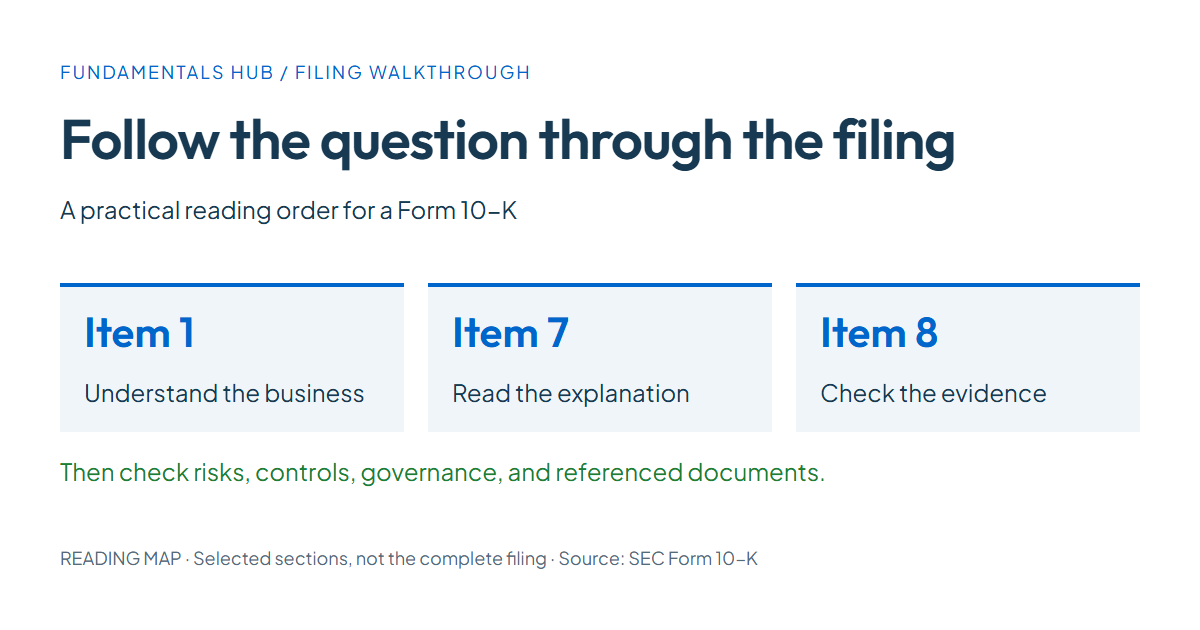
Where does a 10-K explain why sales changed, and where can you check that explanation? The answer spans management's discussion, financial statements, and accounting notes. Reading just one of those sections leaves part of the evidence behind.
Learning how to read a 10-K filing means knowing where each question belongs and following the cross-references. This guide maps the document and traces one historical Apple sales example through it. It covers reading and verification, rather than valuation or a recommendation about the shares. For a first research worksheet, use the beginner's fundamental analysis guide.
A Form 10-K is a company's annual SEC filing. The company prepares it; the SEC does not vouch for its accuracy, as the SEC's investor bulletin explains. That distinction gives the reader a job: connect the narrative to the supporting disclosures.
1. How to Read a 10-K Filing With a Section Map
- Form 10-K
- A company's annual SEC filing.
- MD&A
- Management's Discussion and Analysis of financial condition and results of operations.
- incorporation by reference
- Including specified material from another document by an explicit reference.
Use the table of contents to match a research question to its disclosure, then follow the references across sections. A useful reading order begins with the business, tests management's explanation against the statements, and checks risks, controls, and governance afterward.
The current Form 10-K provides the section names below. This is a reading map, not an exhaustive list of required disclosures; some requirements and exemptions depend on the issuer. Keep the filing's own contents open beside your notes.
| Location | What to look for | Question to record |
|---|---|---|
| Item 1: Business | Products, customers, markets | What earns the revenue? |
| Item 1A: Risk Factors | Disclosed business and security risks | What could undermine the explanation? |
| Item 1C: Cybersecurity | Cybersecurity disclosures | Where are risk management and oversight discussed? |
| Item 7: MD&A | Management's discussion of results and liquidity | Why does management say results changed? |
| Item 7A: Market Risk | Exposure to market risks | Which market movements matter? |
| Item 8: Financial Statements | Statements, notes, audit reports | Do the amounts support the narrative? |
| Item 9A: Controls and Procedures | Controls disclosures | What conclusions or weaknesses are reported? |
| Part III: Items 10-14 | Governance, compensation, ownership, related matters | Is another document incorporated? |
| Item 15: Exhibits and Schedules | Exhibit index and supporting documents | Which referenced agreements need reading? |
One navigation trap: Item 6 is now reserved. An older guide may direct you there for selected financial data. Use the current form and the actual filing instead of assuming an old checklist still describes the document.
Treat the map as a set of bookmarks. You can read Item 1 first, jump to Item 7 for an explanation, and test it in Item 8. Return to the remaining disclosures as the question develops; this order does not make the other sections dispensable.
2. Confirm the Document, Dates, and Units
Identify the annual filing before taking notes, and distinguish its reporting period from the date it reached EDGAR. Record the company, form, accession, fiscal year-end, currency, and scale so another reader can locate the same evidence and reproduce your work.
Search the company in EDGAR, filter for Form 10-K, and open the filing detail page. Select the main 10-K document rather than an exhibit. The SEC's EDGAR research guide explains the filing types and search tools. If the form is 10-K/A, inspect what the amendment changes.
This walkthrough uses Apple's FY2025 filing detail page: accession 0000320193-25-000079, fiscal year ended September 27, 2025, filed October 31, 2025. It is a historical practice case. A current company assessment also requires later disclosures.
On the detail page, open aapl-20250927.htm. The fiscal year-end is not the filing date. Within a single document, a cover-page share count can also use a different measurement date from the balance sheet. Copy the date next to the amount you actually use.
Check units at each table. The Apple sales amounts below are USD millions, so 416,161 represents $416.161 billion. Per-share figures and share counts can use different scales. A correct digit string with the wrong unit becomes an incorrect financial observation.
3. Read the Business, Then Test the MD&A
Summarize what the company sells before interpreting management's explanation of annual changes. Pick one claim from the discussion, locate its supporting table, and write down what the figures establish, what management attributes the change to, and what still needs investigation.
MD&A means Management's Discussion and Analysis. Use Item 1 to establish the business model, then Item 7 to identify an explanation you can test. Separate the disclosed change from a claim about its cause. Growth alone does not prove stronger pricing, customer retention, or demand.
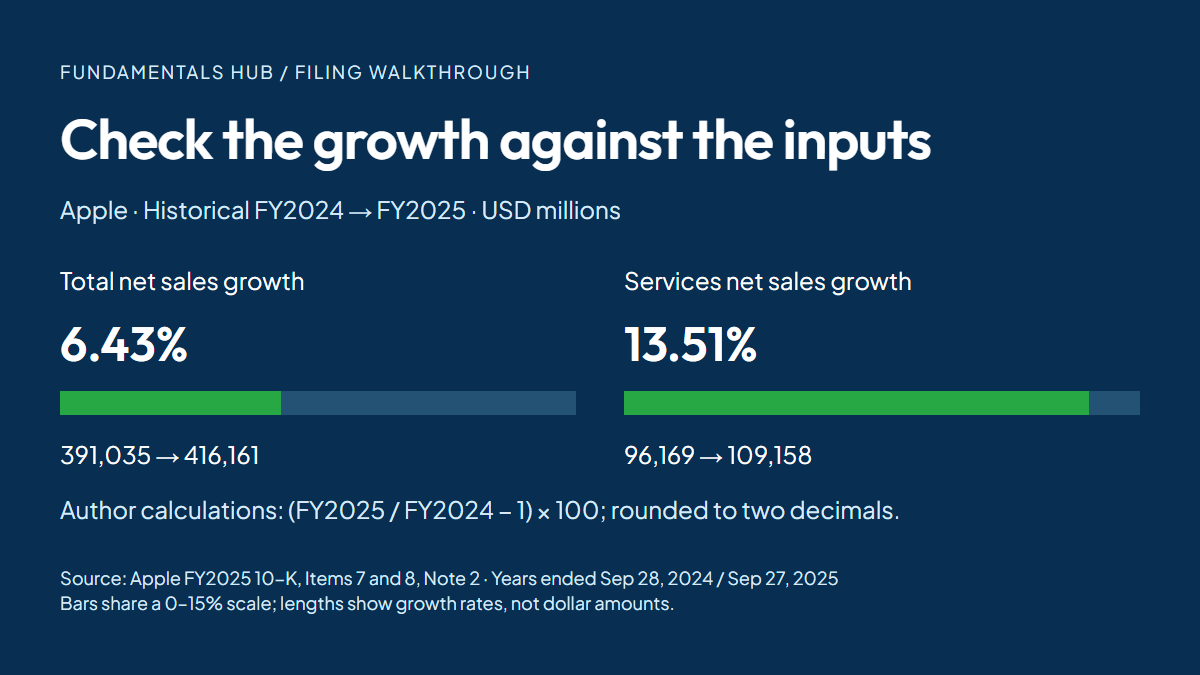
In Apple's FY2025 10-K, Item 7's product and service sales table provides the inputs below. The same amounts appear in Item 8's income statement and Note 2, Revenue. Read the FY2024 comparative column from this same report.
| Net sales, USD millions | FY2024 | FY2025 |
|---|---|---|
| Total | 391,035 | 416,161 |
| Services | 96,169 | 109,158 |
Calculate total sales growth as (416,161 / 391,035 - 1) × 100 = 6.43%. Services growth is (109,158 / 96,169 - 1) × 100 = 13.51%. These are author calculations rounded to two decimals; Apple's table displays the changes at whole-percent precision.
The observation is that Services grew faster than total sales. Apple's MD&A attributes the Services increase primarily to advertising, the App Store, and cloud services. That attribution is management's explanation; these aggregate figures do not independently measure each contributor or establish a forecast.
Write a follow-up question beside the result: which revenue categories and accounting treatments sit inside Services? That sends the reading into the notes instead of ending with a percentage. A reliable explanation needs both the amount and its scope.
4. Follow the Amount Into the Notes
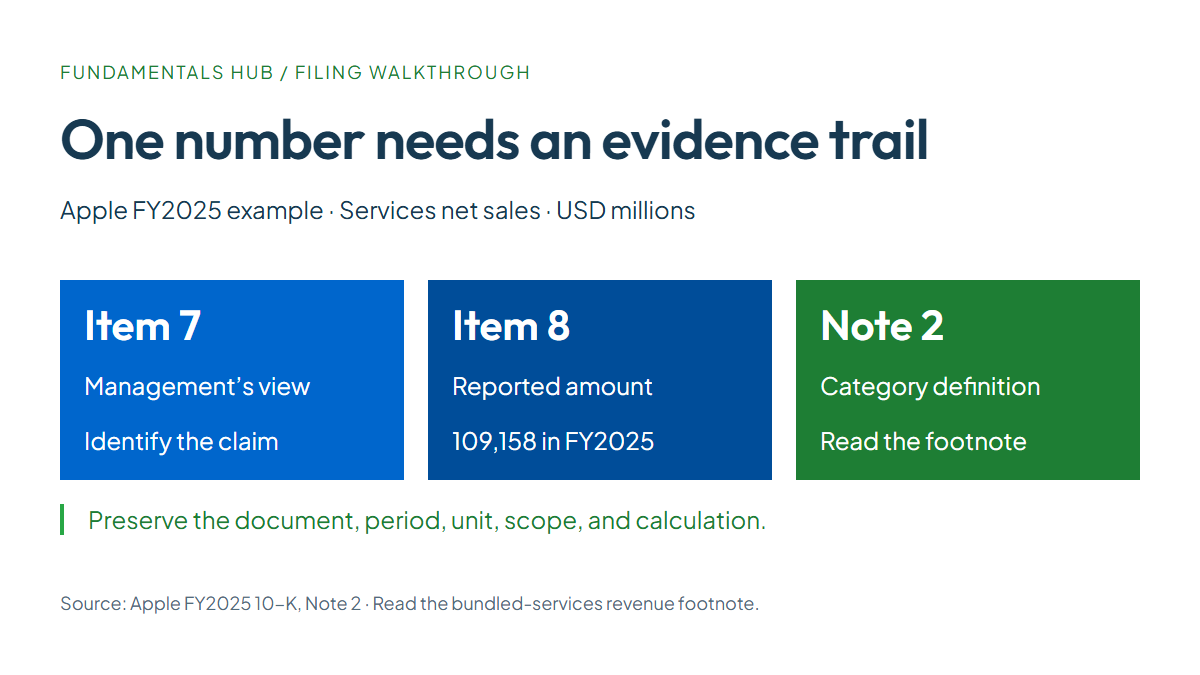
Trace the selected amount from management's discussion to the statement and the relevant accounting note. Confirm that the label, period, unit, and consolidation scope agree, then read the policy or breakdown that explains what the reported total includes and excludes.
For this example, follow Services net sales into Note 2. Its table includes a footnote explaining that Services includes amortization of deferred value for services bundled with certain products. Keep that qualification beside the sales figure. “Services” is a disclosed accounting category, not a synonym for cash subscription receipts.
Save a short evidence trail: document URL, Item 7 table, Item 8 statement, Note 2, units, fiscal columns, and your calculation. The financial statements guide explains the statements themselves; here, the task is preserving the path between a claim and its support.
For programmatic extraction, an XBRL tag name is insufficient identification. The same concept can have different dates, units, or dimensional contexts. Verify the context attached to the fact before treating it as the consolidated annual total. The XBRL data guide covers those parsing issues.
(Fundamentals Hub provides standardized income statement, balance sheet, and cash flow fields for covered SEC filings, which can reduce manual copying of statement totals.)
That convenience still leaves the narrative and notes to read. A normalized total cannot by itself explain a contract, an estimate, or the reason management gave for a change. Keep your interpretation attached to the original disclosure.
5. Check Risks, the Audit, and Controls
Read risk disclosures alongside the explanation you are testing, then examine the audit reports and controls discussion for qualifications that affect confidence in the figures. Record the precise conclusion and scope; a favorable audit opinion does not eliminate business uncertainty.
Return to Item 1A and select a risk relevant to your question. Read Item 1C for cybersecurity and Item 7A for market-risk disclosures where applicable. Avoid treating the length of a risk section as a score. Instead, record the mechanism by which a disclosed exposure could affect operations, revenue, or cash.
Item 8 contains the financial statements and associated audit reporting; Item 9A addresses controls and procedures. These are connected but distinct checks. The PCAOB's audit-report guidance explains the standard unqualified auditor's report, including its focus on whether statements present fairly, in all material respects, under the applicable accounting framework.
Read the report's actual wording, any explanatory paragraphs, and the period covered. Where critical audit matters are reported, use them to locate the relevant accounts and notes. Their presence is not, by itself, a finding that the statements are misstated or a reason to reject the company.
In Item 9A, distinguish management's conclusions from any auditor's opinion on internal control. Not every issuer has the same auditor-attestation requirement. If a material weakness is disclosed, record the affected process and remediation discussion rather than reducing it to a generic red flag. The SEC's current form instructions point to the applicable controls rules.
6. Follow References and Finish the Reading Record
Follow incorporated references before calling the review complete, and keep unresolved questions separate from observations. Finish with the filing identity, the claim tested, its supporting disclosures, your calculation, and the additional documents needed to assess governance or later company developments.
Part III can direct you to a proxy statement for information about directors, compensation, ownership, or related matters. That is incorporation by reference: specified material in another document supplies part of this filing's disclosure. Check the cover page and the relevant item for the precise reference.
Apple's FY2025 cover page identifies portions of its definitive proxy for the 2026 annual meeting as incorporated into Part III where indicated. Follow that reference when researching those items. A short Part III does not mean the company has no executive compensation or ownership information to disclose.
Inspect Item 15's exhibit index when a question depends on an agreement or another supporting document. Follow the cited exhibit and check its date. Do not assume every material detail is repeated in the body of the annual report.
A finished record might say: “Apple FY2025 Services sales increased 13.51% using USD-million figures in the FY2025 report. Item 7 gives management's explanation; Item 8 and Note 2 support the amounts and category definition. The calculation describes history, and later disclosures remain outside this exercise.”
Knowing how to read a 10-K filing is useful when another reader can retrace that record. Keep the source and interpretation in separate columns. If a question remains unanswered, name the missing evidence rather than filling the gap with a confident sentence.
FAQ: Reading and Checking a 10-K
These answers address document navigation, historical comparisons, cross-references, and audit interpretation. Use them while checking a specific disclosure, and return to the issuer's filing for its wording; a general reading method cannot determine the meaning of every company-specific accounting judgment.
Is the shareholder annual report always the same as the 10-K?
No. A company can use its 10-K as its shareholder annual report, or publish a separate annual report with additional presentation material. Confirm that the document you are reading contains the filed Form 10-K and its supporting disclosures.
Why is Item 6 empty in a recent 10-K?
The current Form 10-K marks Item 6 as reserved. Older guides can still describe a selected-financial-data section there. Use the present form and the issuer's contents, then locate the comparative amounts in the statements and management's discussion.
What if Part III sends me to a proxy statement?
Read the incorporation language and obtain the specified definitive proxy statement through EDGAR or investor relations. Follow the relevant sections for the question you are researching. The reference does not mean every page of the proxy is incorporated into the 10-K.
Can I take the first matching XBRL fact for an annual amount?
No. Check its reporting dates, unit, dimensional context, and filing source. A matching tag can identify a different interval or scope. Reconcile the extracted figure to the intended table in the annual filing before using it in your worksheet.
Where should I compare the audit opinion with the controls conclusion?
Read the financial statement audit report with Item 8, then the controls discussion in Item 9A. Record which opinion or conclusion comes from management and which from the auditor, along with its scope and period. The financial statement audit and an opinion on internal control address different questions.