 Fundamentals Hub
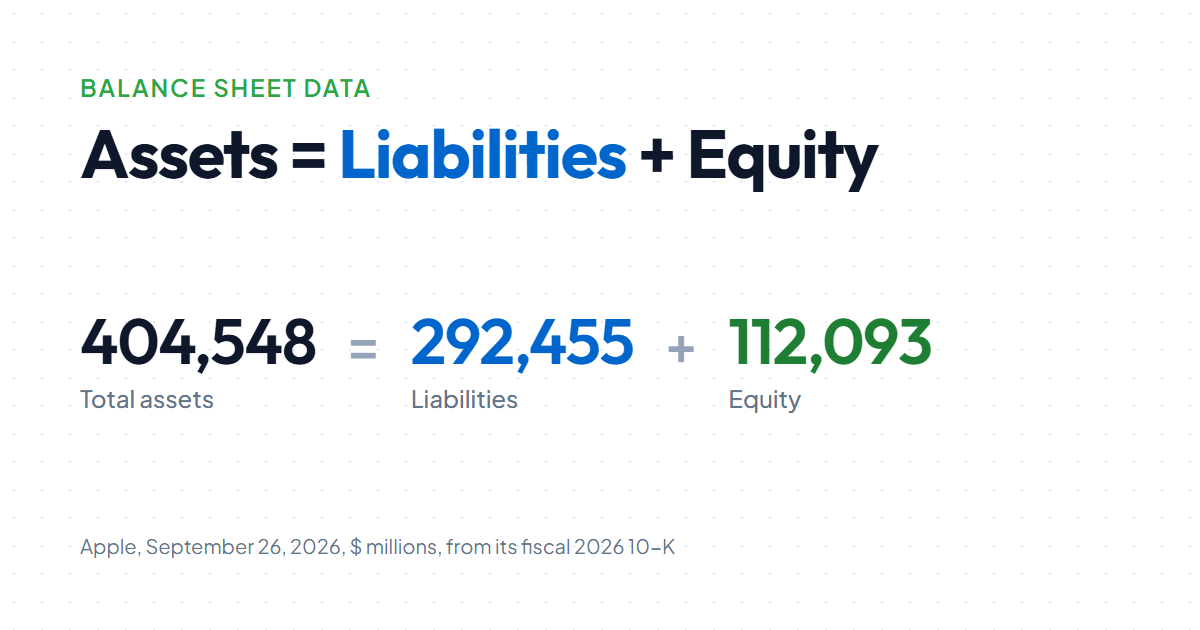
You are pulling total liabilities from the SEC's company facts JSON for a list of large companies. Apple's fiscal 2026 10-K returns $292.5 billion under the Liabilities tag. Amazon returns nothing. Walmart and McDonald's come back empty too. These companies did not forget to report their obligations: their filings never tag a single total liabilities amount, so you have to reconstruct it from the accounting identity.
Rebuilding it correctly takes more than one subtraction. This explainer covers what assets, liabilities, and equity measure, how to check that a balance sheet balances, and five things that break naive parsers: missing totals, minority interests, "mezzanine" equity that sits on neither side, equity below zero, and balance sheet dates that repeat across filings.
It is not a guide to reading all three statements or to ratio analysis. For the links between the balance sheet, income statement, and cash flow statement, see how company financial statements connect. Leverage and liquidity ratios are covered in the financial ratio reference.
What Balance Sheet Data Records
- noncontrolling interest
- The share of a consolidated subsidiary owned by investors outside the parent company, also called minority interest.
- mezzanine
- Temporary equity: redeemable securities presented between liabilities and permanent equity because they can be redeemed at the holder's option or on events outside the company's control.
- treasury stock
- Shares a company has repurchased and holds, recorded as a deduction from shareholders' equity.
Balance sheet data is a snapshot of what a company owns, what it owes, and what is left for shareholders on one specific date. Each amount is a position at a point in time, not activity over a period, and that single property changes how you store, compare, and combine it.
The three blocks are:
- Assets: resources the company controls, such as cash, receivables, inventory, property, and intangibles. Current assets are expected to turn into cash within a year; the rest are noncurrent.
- Liabilities: obligations to outsiders, such as supplier invoices, debt, lease obligations, deferred revenue, and tax liabilities. Industrial and consumer companies split them into current and noncurrent on the same one-year line. Banks, insurers, and broker-dealers present unclassified balance sheets with no current subtotal at all.
- Equity: the residual claim of shareholders, what remains after liabilities are subtracted from assets. It is made up of paid-in capital, retained earnings, accumulated other comprehensive income (unrealized gains and losses not yet in net income), and reductions for repurchased shares.
The identity tying them together is Assets = Liabilities + Equity. It holds by construction, because double-entry bookkeeping records both sides of each transaction.
The point-in-time nature shows up directly in SEC XBRL. A revenue fact carries both a start and an end date. A balance sheet fact carries only end; XBRL calls this an instant. Quarterly balance sheet data therefore has none of the year-to-date problems of income statement figures. A June 30 balance sheet in a 10-Q describes June 30, full stop. (The EPS data guide shows how differently flow figures behave.)
Checking Assets = Liabilities + Equity on Apple's Balance Sheet
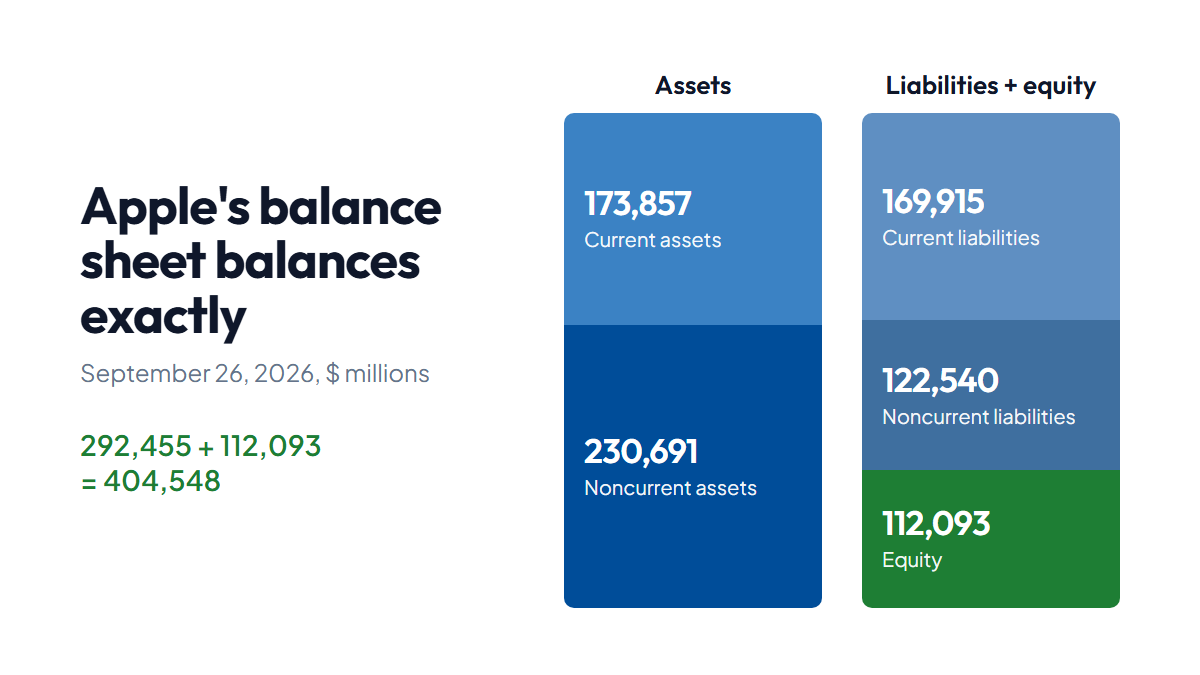
The fastest way to understand balance sheet data is to verify the identity on a real filing. Apple's fiscal 2026 10-K, for the year ended September 26, 2026, reports each total you need, so the check takes one line of arithmetic.
| Apple, Sept 26, 2026 | $ millions |
|---|---|
| Current assets | 173,857 |
| Noncurrent assets | 230,691 |
| Total assets | 404,548 |
| Current liabilities | 169,915 |
| Noncurrent liabilities | 122,540 |
| Total liabilities | 292,455 |
| Total shareholders' equity | 112,093 |
Liabilities plus equity: 292,455 + 112,093 = 404,548, an exact match with total assets.
Two details in that table deserve a second look. First, Apple's current assets exceed its current liabilities by only $3.9 billion, a thin cushion for a company of its size. Two reported lines explain it: $82,252 million of accounts payable owed to suppliers, and $80,213 million of marketable securities classified as noncurrent, which keeps them out of current assets. A year earlier, the same two effects left current liabilities $17.7 billion above current assets.
Second, equity is small relative to the size of the business: about 28% of total assets. Apple's equity section shows $104,815 million of common stock and paid-in capital, retained earnings of $13,700 million, and accumulated other comprehensive loss of $6,422 million. Those three add to $112,093 million.
Retained earnings were negative a year earlier, an accumulated deficit of $14,264 million at September 27, 2025. That deficit did not come from losses: more than a decade of buybacks and dividends had together exceeded cumulative profit. In fiscal 2026, net income of $132.2 billion outran $86.4 billion of repurchases and $15.7 billion of dividends, and the balance turned positive.
When a Total Is Missing: Amazon's Liabilities
Not every company tags every subtotal. Amazon's 10-K for 2025 reports a LiabilitiesAndStockholdersEquity fact of $818,042 million and a StockholdersEquity fact of $411,065 million, but no Liabilities fact at all. The total is implied by the statement but never tagged.
The derivation is straightforward when nothing else sits between liabilities and equity:
- Total liabilities and equity: $818,042M
- Less total stockholders' equity: $411,065M
- Derived total liabilities: $406,977M
Amazon is not unusual. In a November 2026 check of the latest 10-K filings from 76 large US companies, 22 had no Liabilities fact, including Walmart, McDonald's, Coca-Cola, Disney, Oracle, Merck, and Intel. Any screen that filters on total liabilities without a fallback silently drops all of them.
The same company shows why debt and liabilities are different questions. Amazon's long-term operating lease liabilities were $76,597 million at the end of 2025, larger than its $65,648 million of noncurrent long-term debt. Lease obligations count in total liabilities, but whether they count as "debt" is a definition you choose; the financial ratio reference walks through the options. Write your definition down before comparing leverage across companies.
The Fourth Bucket: Minority Interests and Mezzanine Equity
Subtracting equity from total liabilities and equity only works when "equity" means the right thing. Two items make it ambiguous: noncontrolling interests, and redeemable securities that accountants place between liabilities and equity.
Walmart's balance sheet for the year ended January 31, 2026 contains both:
| Walmart, Jan 31, 2026 | $ millions | XBRL tag |
|---|---|---|
| Total liabilities and equity | 284,668 | LiabilitiesAndStockholdersEquity |
| Shareholders' equity (Walmart only) | 99,617 | StockholdersEquity |
| Nonredeemable noncontrolling interest | 6,270 | MinorityInterest |
| Total equity including NCI | 105,887 | StockholdersEquityIncludingPortionAttributableToNoncontrollingInterest |
| Redeemable noncontrolling interest | 293 | RedeemableNoncontrollingInterestEquityCarryingAmount |
A noncontrolling interest (NCI, still called minority interest in many filings and in the XBRL tag name) is the share of a consolidated subsidiary owned by outside investors. Walmart consolidates 100% of those subsidiaries' assets and liabilities, so the external owners' slice has to appear somewhere: it sits inside total equity, but not inside Walmart shareholders' equity.
Redeemable NCI is a stake that can be redeemed at the holder's option or on events outside the company's control. SEC rules keep such securities out of permanent equity, the ordinary shareholders' equity section, and present them as "temporary" or "mezzanine" equity. That amount is neither a liability nor permanent equity, so the balance sheet identity really has four parts: Assets = Liabilities + Temporary equity + Total equity.
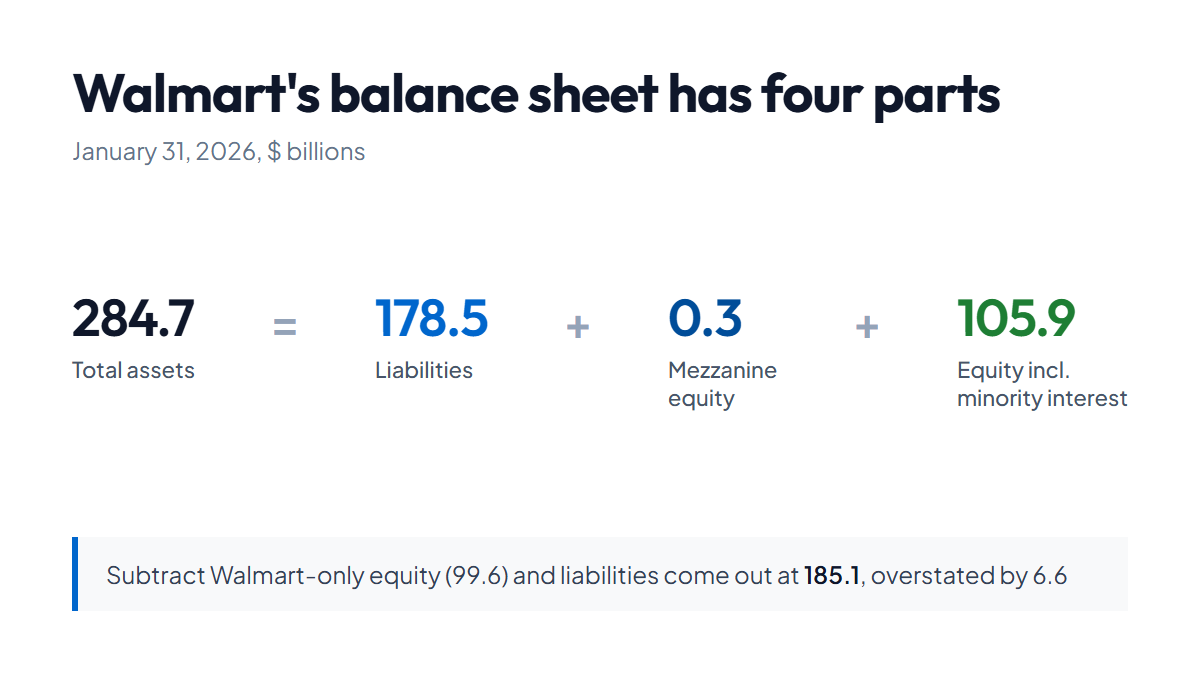
Apply the one-step subtraction to Walmart and it goes wrong. Total liabilities and equity minus Walmart-only equity gives $185,051 million. The correct amount is 284,668 - 105,887 - 293 = $178,488 million. The shortcut overstates liabilities by $6,563 million, exactly the NCI plus the redeemable NCI.
Match the equity amount to the numerator. Return on equity built on net income attributable to Walmart should use Walmart shareholders' equity. A leverage ratio built on consolidated debt should use total equity including NCI, because the consolidated debt supports the whole group.
(Fundamentals Hub applies this four-part identity when it derives a missing total: total_equity includes noncontrolling interest, and temporary equity, meaning redeemable NCI plus any redeemable shares of the parent, is returned separately as redeemable_noncontrolling_interest.)
Negative Equity Is Not Always Distress
Equity is a residual, so nothing stops it from falling below zero. A negative amount means recorded liabilities exceed recorded assets. That can signal trouble, but at several large, profitable companies it is the arithmetic result of buybacks.
McDonald's reported total shareholders' equity of -$1,791 million at December 31, 2025, on total assets of $59,515 million. The equity section explains why. Retained earnings of $70,282 million plus $9,641 million of paid-in capital are almost entirely offset by treasury stock of $79,316 million, the cost of shares repurchased over the years. An accumulated other comprehensive loss of $2,414 million then pushes the total below zero.
Repurchases funded partly with debt shift the balance sheet toward liabilities without making the business less profitable. The same pattern appears in the latest annual data for Starbucks, Lowe's, Booking Holdings, Philip Morris International, and Domino's, among others.
For data work, the consequence is simple: exclude negative-equity companies before ranking on price-to-book, debt-to-equity, or return on equity, because each of those ratios flips sign or turns meaningless below zero. None of this tells you whether the debt load is sustainable; that takes cash flow, which the balance sheet alone cannot show, as the free cash flow guide explains.
Pulling Balance Sheet Data Without Double Counting
Two parsing details catch almost everyone who works with raw SEC balance sheet data. Both come from the fact that a balance sheet date appears in more than one filing.
Every 10-Q repeats the prior fiscal year-end balance sheet as a comparative column, and so does the next 10-K. Apple's total assets of $359,241 million at September 27, 2025 appear five times in the company facts JSON. The original copy, from the fiscal 2025 10-K, is tagged fy: 2025 and fp: FY. The other four come from the three fiscal 2026 10-Qs and the fiscal 2026 10-K filed on November 3, 2026, and all four are tagged fy: 2026, with fp values of Q1, Q2, Q3, and FY.
Those fields describe the filing the fact came from, not the date the fact describes. Group balance sheet facts by their end date and never use fy and fp to assign a date. Then pick one filing per date, identified by its accession number (accn), and take every balance sheet tag from that filing. Choosing the newest copy of each tag independently can mix an original and a restated filing, and the identity stops adding up.
The SEC offers a shortcut: one copy of each instant carries a frame field, a deduplicated label such as CY2025Q3I. The frames API uses the same labels, with an I suffix for instants; request CY2025Q4 instead of CY2025Q4I for Assets and it returns a 404. Frames are calendar-aligned, so Apple's September fiscal year-end lands in CY2025Q3I, not Q4. The XBRL data guide covers contexts and frames in more depth.
Here is a short Python check that pulls the latest annual balance sheet for four companies from the Fundamentals Hub API and tests the four-part identity. The pause between calls keeps it inside the free tier's limit of one request per minute:
import os
import time
import requests

BASE_URL = "https://fundamentalshub.com/api/v2"
API_KEY = os.environ["FUNDAMENTALS_HUB_API_KEY"]

def latest_balance_sheet(ticker):
    resp = requests.get(
        f"{BASE_URL}/companies/{ticker}/financials",
        params={"fields": "balance", "period": "annual", "limit": 1},
        headers={"X-API-Key": API_KEY},
        timeout=30,
    )
    resp.raise_for_status()
    rows = resp.json()["data"]
    return rows[0] if rows else None

for i, ticker in enumerate(["AAPL", "AMZN", "WMT", "MCD"]):
    if i:
        time.sleep(61)  # free tier: 1 request per minute
    bs = latest_balance_sheet(ticker)
    if bs is None:
        print(f"{ticker}: no annual data")
        continue
    assets = bs["total_assets"]
    liabilities = bs["total_liabilities"]
    equity = bs["total_equity"]  # includes noncontrolling interest
    mezzanine = bs["redeemable_noncontrolling_interest"] or 0
    if None in (assets, liabilities, equity):
        print(f"{ticker}: incomplete balance sheet")
        continue
    gap = assets - liabilities - mezzanine - equity
    print(f'{ticker} {bs["period_end"]}: assets {assets / 1e9:,.1f}B, '
          f'liabilities {liabilities / 1e9:,.1f}B, '
          f'mezzanine {mezzanine / 1e9:,.1f}B, equity {equity / 1e9:,.1f}B, '
          f'gap {gap:,.0f}')
The output on November 10, 2026 (rerun it later and each line moves to the company's newest annual balance sheet):
AAPL 2026-09-26: assets 404.5B, liabilities 292.5B, mezzanine 0.0B, equity 112.1B, gap 0
AMZN 2025-12-31: assets 818.0B, liabilities 407.0B, mezzanine 0.0B, equity 411.1B, gap 0
WMT 2026-01-31: assets 284.7B, liabilities 178.5B, mezzanine 0.3B, equity 105.9B, gap 0
MCD 2025-12-31: assets 59.5B, liabilities 61.3B, mezzanine 0.0B, equity -1.8B, gap 0
Read the zeros carefully. For Apple, all four inputs were reported, so the zero gap is an independent check. For Amazon, Walmart, and McDonald's, total liabilities was derived from this same identity, so a zero gap confirms internal consistency rather than a second source. The None checks matter across a wider universe: a field stays empty when a filing reports too little to derive it.
FAQ: Working With Balance Sheet Data
Why do some companies have no total liabilities in their SEC data?
XBRL tags follow the statement as presented. If the balance sheet lists liability lines without a subtotal, there is normally no Liabilities fact to pull. Derive it as total liabilities and equity (or total assets, if that tag is missing) minus total equity including noncontrolling interest, minus any temporary equity.
What if a filing tags parent equity and minority interest but no total equity?
Add them. Total equity including NCI equals StockholdersEquity plus MinorityInterest. Walmart's figures show the arithmetic: $99,617 million plus $6,270 million equals the $105,887 million it tags as the combined total. Check the result against the balance sheet identity before using it.
Where does redeemable noncontrolling interest go?
Between liabilities and equity, as temporary or mezzanine equity. It can be redeemed at the holder's option or on events outside the company's control, so SEC rules keep it out of permanent equity, but it is not a liability either. Leave it out of both totals and include it in the identity check.
Is a company with negative shareholders' equity insolvent?
Not necessarily. At McDonald's, treasury stock from decades of buybacks nearly offsets retained earnings and paid-in capital, and accumulated other comprehensive losses push the total below zero. Whether obligations can be serviced depends on cash flow, which the balance sheet alone does not show.
Why does the same balance sheet value appear under several fiscal periods?
Each 10-Q and the following 10-K repeat the prior year-end balance sheet as a comparative, and the company facts JSON labels every copy with the filing's own fiscal year and period. Key balance sheet facts by their end date, take all tags for a date from one filing, or use the copy that carries a frame label.